How Does a Mobile Billboard Truck Work?
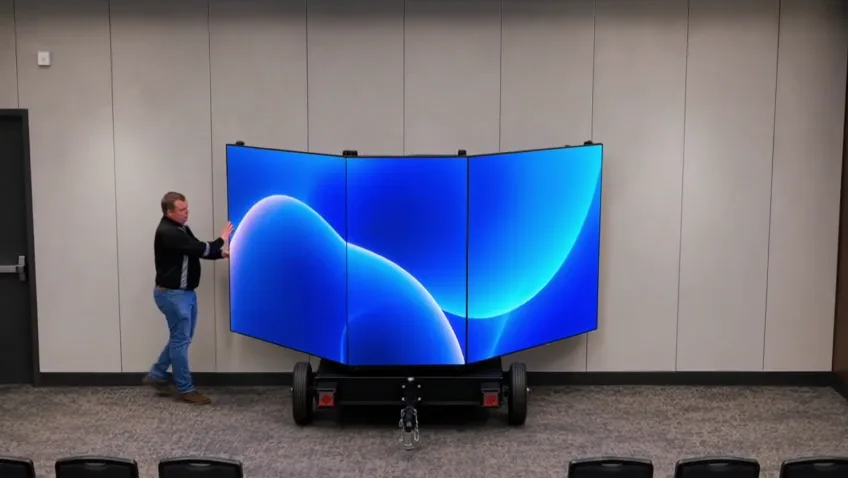
A mobile billboard truck carries a large LED screen and its own generator. You send artwork as a file, it loads onto the screen, and the truck drives a route you picked or parks where your audience is. No power hookup, no printing. Here is the whole process, start to finish.
The parts of the truck
Four things make it work. Everything else is detail.
The screen
A grid of LED panels. Each panel is a square of tiny lights. Bolt enough together and you have a billboard. Ours are 3mm pitch, meaning the lights sit 3mm apart, which is close enough to look sharp from a few feet away.
The generator
The screen needs power and there is no outlet on the road. A diesel generator rides on board, sized to the screen. Roughly 350 watts per ten panels.
The controller
A small computer that holds your artwork and sends it to the panels. This is what the operator loads your file into.
The frame or lift
On fixed units, a frame holds the screen. On fold-out units, hydraulics raise the screen and open the side panels. Raising it lifts the ad above the crowd so it can be seen from further away.
What happens on the day
Step 1: Your artwork is loaded
You send an image or a video file. It goes into the controller and onto the screen. This takes minutes, not days, because nothing is being printed.
Step 2: The truck goes to the route
The driver takes the route you agreed. For a driving campaign, that is a loop through the area you picked. For a parked campaign, the truck goes to the spot and sets up.
Step 3: The screen deploys
On a driving run the screen is already live. On a fold-out unit that is parking, the operator levels the trailer on its jacks, raises the mast, and opens the panels. On our fold-out models the screen rises about twenty feet and opens to around thirty feet wide.
Step 4: The generator runs the screen
It runs for the booked hours. Nothing needs plugging in.
Step 5: You get proof
At the end of the run you receive confirmation of where the truck went and when, so you know what you paid for happened.
How the screen stays visible in daylight
This is the part people are most surprised by. A television outdoors at noon is unreadable. A proper outdoor LED screen is not, and the difference is brightness.
Brightness is measured in nits. A phone is a few hundred. A living room TV is around 500. Our outdoor panels run 8,000. That is what it takes to compete with the sun.
The other half is the coating on the panels. Ours use a patented UV coating that protects a fine 3mm pitch outdoors, which normally would not survive sun and weather.
Mobile billboard versus static billboard
A short comparison, since this is the question that usually comes next.
- Setup time. Static needs vinyl printed and hung, often two to four weeks. Mobile needs a file, and can run the same week.
- Location. Static is one fixed spot. Mobile picks a route and can cover several areas in a day.
- Changing the ad. Static means reprinting. Mobile means sending a new file.
- Share of screen. A static board is all yours. A shared digital board rotates you with others. A mobile billboard is all yours for the whole run.
- Long campaigns. Static usually costs less per day over months in one place.
Is it worth it?
It is worth it when your audience moves, when your dates are short or fixed, or when you need to be impossible to ignore for a specific window. A truck at a stadium on game night reaches a crowd no fixed sign can.
It is not worth it if you want the same message in the same place for a year. Buy a static billboard for that, and spend the difference on the artwork.
If you are weighing it up, call 1-888-LED-5010. If mobile is wrong for what you are doing, we will say so.
Common questions
How does a mobile billboard truck work?
It carries a large LED screen and an onboard generator. Your artwork loads as a file into a controller, the truck drives the route you chose or parks where your audience is, and the generator powers the screen for the booked hours.
Does a mobile billboard need to plug in?
No. A diesel generator rides on board, sized to the screen at roughly 350 watts per ten panels, so there is no hookup to arrange.
How long does it take to change the ad?
Minutes. The artwork is a file loaded into the controller. Nothing is printed, so you can run different messages at different times of day.
How is the screen visible in bright sunlight?
Brightness, measured in nits. Our outdoor panels run 8,000 nits, compared with about 500 for a living room TV, plus a patented UV coating that lets a fine 3mm pitch survive outdoors.
How wide does a fold-out screen get?
On our fold-out models the mast raises the screen about twenty feet and the side panels open to roughly thirty feet wide.
Is mobile billboard advertising worth it?
It is worth it when your audience moves, your dates are short, or you need concentrated attention in a specific window. For the same message in one fixed place for a year, a static billboard usually costs less.